January 27, 2024: Latin America conference in London18th annual conference in solidarity with Latin American progressive movements. Nicaragua Solidarity Campaign Action Group (NSCAG) will be holding a seminar during the Conference – ‘Nicaragua: The Threat of a Good Example’. Speakers: Roger McKenzie, International Editor, Morning Star; Julie Lamin, Chair, NSCAG Executive Committee and Luis Erick Rodriguez, Nicaraguan Ambassador to the UK. Chair: Tony Burke, Member of NSCAG Executive Committee and Member, London Print Branch UNITE
February 10-19: The Bird Brigade: Birding in Solentiname Arquipelago
March 2-10: Sindicatos & Solidaridad: Labor Movements in Nicaragua (Meet with unions and labor activists in all sectors from teachers to motorcycle taxis; Tour new hospitals & maternal wait homes with health care workers unions; Visit unionized street vendors at work; a free trade zone factory & meet with unionized workers; low-income housing projects; a women’s coffee co-op; a women’s police station)
July 9-21: Solidarity in Action: Celebrating 45 Years of Revolution in Nicaragua
November 8-17: Salud & Solidaridad: Hands-On Healthcare in Nicaragua
Sign up to receive the Nicaragua Solidarity Coalition weekly newsletter; email [email protected]
Our monthly zoom meetings: second Monday of the month (next: January 8), 2:30 PM ET. Email [email protected] in advance to request Zoom access for the meeting, or to make other inquiries.
Organizations: Apply for coalition membership here This is an important way to increase the influence of our coalition work, as our membership list grows.
2. We strongly express our support and solidarity with the Brotherly Palestinian People whose cause is present in the global consciousness. Nicaragua recognizes the historical struggle and the right of the Palestinian people to self-determination.
3. 10 countries with the highest emissions in the world emit more than 83%, while our country emits less than 0.05% of global emissions. Nevertheless, we suffer the impacts affecting up to 8% of our GDP.
5. It is essential that capitalist countries reduce emissions by at least 50% towards 2030.
7. The root of the reasons for Climate Change is the destructive model of production and consumption of the large capitalist economies. What we knew as climate change has become a Climate Crisis, a Planetary Crisis and a Crisis of Values.
8. Capitalist countries must comply with their financial commitments, at least regarding the previously agreed U$100 billion annually.
10. The capitalist countries have failed to comply with the Paris Agreements, because their emissions continue to increase, exceeding the norm established by science up to four times, and because they are irresponsibly promoting false options, such as carbon neutrality, thereby seeking to shift their responsibilities to developing countries, while continuing to refuse to recognize the just concept of reparations for affected countries.
With Nicaragua’s universal free healthcare system, all prenatal, childbirth and post-natal offered free of charge – premature births, c-sections, neonatal ICU stays and, incredibly, even fetal surgeries are all free. Home births, previously common especially in rural areas, are now nearly unheard-of – 97% of all births are in hospitals. Lay midwives who once attended home births have now been incorporated into the healthcare system to provide prenatal and in-hospital birth support.
For parents who still live far from hospitals, a network of 181 maternity waiting provide space for nearly 70,000 women per year to stay near a hospital for the last two weeks of their pregnancy. Food, housing and vocational training are provided free of charge; women rest and are checked by medical staff regularly and, when they go into labor, they give birth safely in the hospital next door.
.
John Perry: Nicaragua’s Finance Minister Details How U.S. Sanctions Impact Nicaragua’s PoorWhile the US conducts a sustained campaign denigrating the FSLN government, it no longer has the organization within Nicaragua—an extensive network of NGOs, media outlets and “human rights” bodies funded from US sources—that facilitated the attempted 2018 coup. These have been dislodged by the Sandinista government.
The economic warfare of sanctions on Nicaragua are of three kinds. First are those aimed at restricting Nicaragua’s access to international bodies such as the International Monetary Fund and World Bank. Second are trade restrictions, directed at Nicaraguan exports. Third are personal sanctions, now covering dozens of individual Nicaraguan officials.
Nicaragua has had an excellent reputation for implementing successful projects using financing from bodies such as the World Bank and Inter-American Development Bank. Even before the passage of the NICA Act, Washington began to use its influence within these banks to reject most of the proposals that Nicaragua put forward. This continued even during the pandemic.
Over the five years from 2018, Nicaragua might have expected to receive a total of $2.5-$3 billion in development funding from these bodies. It has only received perhaps 10% of this amount (limited funding related to the pandemic and to the damage caused by two severe hurricanes in November 2020).
Sign up to receive the Nicaragua Solidarity Coalition weekly newsletter; email [email protected]
Our monthly zoom meetings: second Monday of the month (next: January 8), 2:30 PM ET. Email [email protected] in advance to request Zoom access for the meeting, or to make other inquiries.
Organizations: Apply for coalition membership here This is an important way to increase the influence of our coalition work, as our membership list grows.
3. The original peoples of Our Continental and Caribbean America, our ancestors, were visible to the Western and Christian world all the time they invaded us and colonized us, destroying our culture and the worldview of our original peoples, thus committing one of the greatest genocides in the history of Mankind, wiping out millions of human beings and extracting their valuable minerals with which the Western powers enriched themselves.
4. Imperialism, fascism and neocolonialism have relentlessly continued their criminal, inhuman policies of blatant theft of natural resources, against all humanity. The brotherly Palestinian People, the inhabitants of Gaza are the latest act of hegemonic imperial savagery. Our militant solidarity with the Palestinian People and our condemnation of the genocide and occupation by global imperialism and the Government of Israel.
10. Simón Bolívar, the Great Liberator of America put himself at the service of the oppressed and swore to break the chains of the dominant empire and generator of misery in our Great Patriotic Nation. Bolivarian thought and action is the antithesis of the Monroe Doctrine designed by the United States Government to dominate and take over our America and the World. Sandino in Nicaragua in the midst of the struggle against the US military aggression in the 20s and 30s of the last century, elaborated the Plan of the Supreme Dream of Bolívar in his vision of struggle for the Sovereignty and National Dignity of Nicaragua, managing to defeat the US invaders.
“Q: What would you say, in a very simple way, have been the greatest achievements of Sandinismo? Denis Moncada: Freedom, ending a dictatorship that was precisely part of the extension of the Monroe Doctrine by the North American Government; freedom, direct participatory democracy, with the participation of the Nicaraguan People; the programs and economic projects that we are developing; the fight against poverty; equity and equality that advances; the education system; free universal health; the construction of infrastructure; the foreign policy of friendship and cooperation, promoting investments of interest to Nicaragua.”
Nicaragua “immediately” withdraws its ambassador from Argentina “Nicaragua announced the withdrawal of its ambassador from Argentina in the face of “repeated statements and expressions” from representatives of the new administration of that country, which will take office next Sunday the 10th, chaired by Javier Milei.
“In the face of repeated statements and expressions from the new rulers, the Government of Reconciliation and National Unity of Nicaragua has proceeded to withdraw its ambassador, fellow writer and communicator, Carlos Midence. The withdrawal is effective immediately,” signed by the country’s Foreign Minister, Denis Moncada Colindres.
Previously, several media outlets reported that the elected president of Argentina decided to exclude several leaders from his inauguration, scheduled for December 10, including the Nicaraguan president, Daniel Ortega. According to several sources, among the leaders who did not receive the invitation are also the president of Venezuela, Nicolás Maduro, that of Cuba, Miguel Díaz-Canel and that of Iran, Ebrahim Raisi. However, it is stated that invitations were sent to leaders Xi Jinping of China, Luiz Inacio Lula da Silva of Brazil, and Vladimir Putin of Russia.
Ortega and his wife, Vice President Rosario Murillo, had spread a message congratulating the Argentine people “for their exemplary and peaceful election day” on November 19, in which Milei triumphed, and stressed that they were “defenders of the principles of non-intervention, “respect for the sovereignty and self-determination of peoples.” On November 19, 2023, Javier Milei achieved 55.69% of the votes in the second round of the presidential elections in Argentina.”
February 10-19: The Bird Brigade: Birding in Solentiname Arquipelago
March 2-10: Sindicatos & Solidaridad: Labor Movements in Nicaragua
9-21 July 9-21: Solidarity in Action: Celebrating 45 Years of Revolution in Nicaragua
.
Nicaragua Solidarity Coalition: nicasolidarity.net Our monthly zoom meetings: second Monday of the month (December 11), 2:30 PM ET
Email [email protected] in advance to request Zoom access for the meeting, or to make other inquiries.
Organizations: Apply for coalition membership here This is an important way to increase the influence of our coalition work, as our membership list grows.
Nicaragua confirms its definitive withdrawal from the OASThe Government of Nicaragua reiterated that the Organization of American States continues to be a ministry of colonies, designed and organized by the US to cover up and justify its aggressive actions against progressive nations. Foreign Minister Denis Moncada, two years after Nicaragua’s decision to leave the OAS, described that organization as interfering and an instrument of intervention. It materializes the extension of the power and interference of the US Government against the independence, sovereignty, well-being, peace and security of the peoples of the hemisphere. Moncada reiterated the interventionist actions of the OAS, transgressing the principles of non-intervention in internal affairs with respect to the sovereignty of the States and the right of the people to choose their own destiny, actions demonstrated in Nicaragua during the failed coup attempt of 2018.
Nicaragua allocates 2024 budget to social investment Iván Acosta, Minister of Finance and Public Credit, reported that the largest resources in Nicaragua’s 2024 budget, focused on social investments and productive infrastructure. National Assembly, Acosta expressed that healthcare, education, the fight against poverty and public investment are priorities.
He stated that 37.5% of social spending is directed to health and education and 61% of the budget is directed to the fight against poverty. Over 51 billion córdobas ($139.5 million) will be conveyed to the public investment program next year, a historic number for the country. “This budget also allocates resources to protect employment and also a five percent salary increase in the public sector.”
The IMF recognizes the resilience of the Nicaraguan economy and predicts growthThe views expressed in this statement are those of the IMF staff and do not necessarily represent the views of the IMF’s Executive Board. Nicaragua’s economy has remained resilient in the face of multiple shocks, supported by appropriate economic policies, substantial buffers, and multilateral support. After a very strong rebound in 2021, the economy grew at a steady pace since 2022 on the back of private consumption and exports. Real GDP is expected to grow by 4% in 2023. Remittances are projected to reach about 28% of GDP at end-2023, double their end-2021 level, driven by the rapid increase of Nicaraguan emigrants. In 2024 and over the medium term, real GDP is projected to grow by about 3.5%, supported primarily by private consumption. These projected growth rates remain below historical averages (2000-17) of 3.9%. On the upside, real GDP growth might be higher than projected due to a more sustained recovery in domestic demand, including investment, and stronger remittances than projected, especially in the near term. The mission supports the authorities’ efforts to sustain medium-term growth through investing in infrastructure.
Vice President Rosario Murillo On the Day of Condemnation of Violence Against WomenThis November 25th, our deepest Fraternal Sentiments of Solidarity go above all to the Women of that Great, Heroic Land of Palestine, where they continue to suffer brutal aggression and unspeakable genocide. [In Gaza, two women are killed every hour, and 67% of the more than 14,000 Palestinians killed are women and children]. To women all over the world, our impassioned Heart… To the Brave and Heroic Women in Africa, Latin America and the Caribbean, Asia, North America, to the Women in all the Continents and Territories of this World, we unite in a Militant, Combative Spirit, repudiating once again all the forms of violence and aggression that afflict us, but do not defeat us. We are writing a New Story. As United, Lucid, Intelligent and Valiant Women, we are the Force of Love, in all the Battles and all the Victories Ahead.
Nicaragua’ message at the meeting of Forum Against Neocolonialism “2. Modern day neocolonial practices as implemented by the United States and Europe represent the continuity of the colonial barbarism imposed through systematic extermination of native communities, the kidnapping of African peoples to convert them into commodities, the destruction of age old cultures and the indiscriminate plundering of our material and cultural riches in Asia and Africa, as well as in our Latin America and Caribbean.
3. Since the beginnings of colonial imposition, our Peoples have heroically fought against occupation, under the banners of National Liberation, Independence, National Sovereignty and Self-determination, and have achieved significant progress in the processes of decolonization.
5. Today, we continue to face the same ideology of domination embraced by Western elites, one characterized by the control and manipulation of the international financial world, by ideological and cultural perversion, and by imperialist, exclusionary, unipolar and racist thinking, accompanied by the irrational deployment of military force to try to enforce their neocolonial will.
8. A particular expression of the attempt to enforce the neocolonialist unipolar vision has been the progressive politicization of the United Nations system, by means of imposing agendas and double standards in Human Rights matters, which have turned UN institutions into extensions of the meddlesome, interventionist foreign policy of the imperial powers.”
Granma: Nicaragua registers important advances in electricity coverageNicaragua today recorded significant progress in electricity coverage with 99.37% electrification nationwide. This year’s goal is to close with 99.4% electricity coverage, reaching more than 1,280,000 homes, which would benefit more than 3,686,000 inhabitants. Renewable energy makes up 60.43% of the total: solar energy (0.41%); hydroelectric (7.55%); geothermal (13.40%); biomass (11.60%); wind (12.58%); thermal (39.57%), and imported energy represents 14.88%.Before the return to power of the FSLN government in 2006, electricity coverage covered only 54% of the population.
Events
December 3: Nicaraguan Migration: Myths and Reality Join us for a webinar where we’ll address misinformation about Nicaraguan migration and shed light on the reality of the life of a migrant to the United States. John Perry, author/ journalist, will discuss Nicaraguan migration to Costa Rica and the US, analyzing trends over time and examining the factors that may be contributing to the current increase in Nicaraguan migration to the US. Lenin Munguía will share his firsthand experience of migrating three months ago from Managua, Nicaragua, to the state of Maryland and his life in the United States. Spanish-English interpretation provided.
February 10-19: The Bird Brigade: Birding in Solentiname Arquipelago
March 2-10: Sindicatos & Solidaridad: Labor Movements in Nicaragua
9-21 July 9-21: Solidarity in Action: Celebrating 45 Years of Revolution in Nicaragua
.
Nicaragua Solidarity Coalition: nicasolidarity.net Our monthly zoom meetings: second Monday of the month (December 11), 2:30 PM ET
Email [email protected] in advance to request Zoom access for the meeting, or to make other inquiries.
Organizations: Apply for coalition membership here This is an important way to increase the influence of our coalition work, as our membership list grows.
We have followed the principles of these development banks [International Monetary Fund, World Bank, Inter-American Development Bank, Central American Bank for Economic Integration] to mobilize resources to fight poverty and extreme poverty, and to mobilize and invest resources in economic infrastructure, in productive infrastructure and for social investment.
During the years of President Ortega’s government, Nicaragua has been recognized as one of the countries with the best performance in the use of international funds. As a result, we had probably gone from mobilizing $70-$80 million in funds annually to $300-$400 million. That is why you can see the great changes in infrastructure that have taken place.
This has fundamentally been a result of our high technical ability in the formulation of projects, in the design of programs and policies, so that we have been able to present high-quality projects to the boards of these institutions.
We emphasized that there can be no financial adjustment, there can be no reforms that do not consider the impact on citizens, the impact on the population.
It is clear after the attempted coup in 2018 that the United States and some European and other governments were blocking measures to guarantee the stability of Nicaragua’s economy, the stability of its public finances, which were measures available via the IMF. They were fully committed to the coup. Therefore, they had no wish to support the people of Nicaragua, let alone its government.
The World Bank said in a meeting that already-approved projects would continue, but any new ones could not go ahead. It is very embarrassing for its administration to handle a situation where the US representatives are ignoring their responsibility to the Bank’s charter, which is to mobilize resources for projects that directly impact the poorest people, that is, education, health, drinking water and sanitation.
The US, which is a big player in [IMF and World Bank], they say that they will never vote against projects that are for basic needs. This is a very important promise, but they seek to avoid this responsibility and instead, in the legislation they passed long before 2018, probably starting originally in 2015, such as the Nica Act and other initiatives such as the Renacer Act [Reinforcing Nicaragua’s Adherence to Conditions for Electoral Reform Act of 2021], they have always striven to make the maximum effort to prevent resources from reaching Nicaragua.
In 2020, with Covid, we were facing the risk of death among a population and they [US and EU] did their utmost not to deliver the resources, failing to comply with the promises of the global leaders to support all countries in the face of the global pandemic that was approaching.
The European countries act with the US to prevent the approval of new projects. Between the Inter-American Development Bank and the World Bank, back in 2016 to 2017 we had projects that could add up, between the two entities, to about $500 million per year. Over the five years from 2018 to 2023 we should have been promised resources of between $2,500 and $3,000 million.
Yet Nicaragua received only $300-$320 million versus a possible total of $3 billion. The resources have been just 10% of what they should have been over this period. We have made great efforts, but we could have done much more if the banks had remained loyal to their charters. That is to say, the banks’ charters have been violated.
The absence of these resources delays programs of high value in the fight against poverty and in creating food security. These financial organizations have these projects, we formulate them jointly. They are convinced of the quality of the projects, but they do not finance them.
Nevertheless, we have managed to overcome the impact of the unilateral coercive measures [sanctions] in terms of the country’s management and in terms of growth. I believe that we are the country with the highest growth [in Latin America] since the pandemic, 15.8%.
The United States does not have shares in the Central American Bank for Economic Integration (CABEI, or BCIE in Spanish (Banco Centroamericano de Integración Económica) The majority owners of BCIE are the Central American countries. We own 52% of the bank, that is, the majority of the bank. It is a much smaller bank, but it is fundamentally under the administration of the Central American states, accompanied by Asian countries, by other countries in the region, and this gives it strength because there is no impact of the aggressive policy of unilateral coercive measures. Of course, they get visits from the State Department, from the US embassy, they do so constantly, but this does not have any effect. Therefore, the Bank for Central American Economic Integration has played a key role and has fulfilled it.
With all the financial institutions we are regarded as the best in Central America. The country is undoubtedly one of the best globally in terms of accountability. The government of President Daniel Ortega has tripled electricity generation in eight years, with the support of the national community and these international organizations.
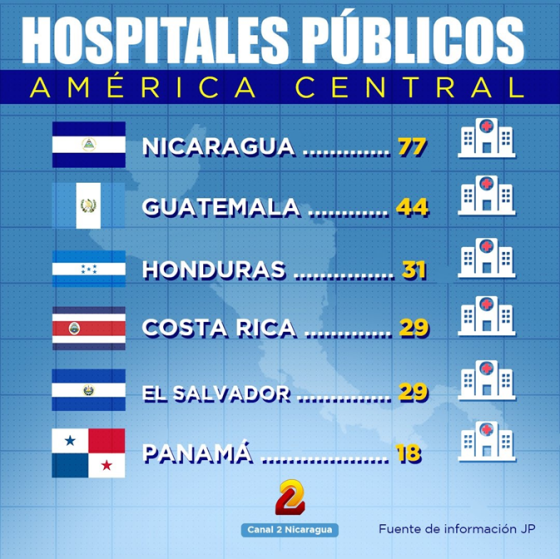
In 16-17 years, the neoliberal governments built only two hospitals and started one more. In contrast we have built 17 hospitals, among them three much more advanced ones, and we are finishing the construction of four more. So that is a huge difference [between the neo-liberal and Sandinista governments] in the same period of 17 years.
When we look at the quality of the highways in 2006, only 30% were in good condition. Out of 2,000 km, there were only 600 kilometers in good condition. Today we are already close to 4,500 kilometers of highways with 85% in good or excellent condition. We are talking about 4,300 kilometers of highways in good condition versus 600.
We are now the safest country in Central America, one of the safest in Latin America, despite people saying that this is a small, poor country. In homicides, we are falling below seven per 100,000 people, when the Central American average is about 30 per 100,000. And kidnappings have been practically zero since 2007 [apart from the period of the attempted coup].
All this is only possible because of the success that President Daniel Ortega has had in public policies: achieving greater social cohesion, achieving income redistribution for the population through health, education, rural programs, financing programs, and definitely putting the citizen, the ordinary person, at the center of public policy.
There are the constant efforts of Nicaraguan workers, peasants, for example the efforts of the 150,000 meat and milk producers, those of the 50,000 coffee producers, of the more than 350,000 agricultural producers, producing coffee, meat and milk. We are in the hands of these entrepreneurs, the vitality of the economy depends on them.
NicaNotes: Good Infrastructure Makes People’s Lives Better On Dec. 7, 2022, the President of the Central American Bank for Economic Integration (CABEI), Dante Mossi, stated that “Nicaragua is the country [in Central America] with the best execution rate for projects. It is the country with the best highway infrastructure. The Nicaragua Government and CABEI are currently carrying out 28-projects totaling more than US$1.89 billion for infrastructure, environmental protection, and the fight against poverty.
From 2007 to date, the Sandinista government has built more than 130,000 homes. National electricity coverage was 99.34% at the end of July 2023, with 70% generation based on renewable sources. Nicaragua Water and Sewage Company (ENACAL) announced that 92% of the population has drinking water service, while in 2006 only 65% of homes had potable water.
December 3: Nicaraguan Migration: Myths and Reality Join us for a webinar where we’ll address misinformation about Nicaraguan migration and shed light on the reality of the life of a migrant to the United States. John Perry, author/ journalist, will discuss Nicaraguan migration to Costa Rica and the US, analyzing trends over time and examining the factors that may be contributing to the current increase in Nicaraguan migration to the US. Lenin Munguía will share his firsthand experience of migrating three months ago from Managua, Nicaragua, to the state of Maryland and his life in the United States. Spanish-English interpretation provided.
January 20-February 1: Advances & Autonomy Brigade: Rights of Indigenous & Afro-Descendant Peoples on Nicaragua’s Caribbean Coast
February 10-19: The Bird Brigade: Birding in Solentiname Arquipelago
March 2-10: Sindicatos & Solidaridad: Labor Movements in Nicaragua
9-21 July 9-21: Solidarity in Action: Celebrating 45 Years of Revolution in Nicaragua
.
Nicaragua Solidarity Coalition: nicasolidarity.net Our monthly zoom meetings: second Monday of the month (December 11), 2:30 PM ET
Email [email protected] in advance to request Zoom access for the meeting, or to make other inquiries.
Organizations: Apply for coalition membership here This is an important way to increase the influence of our coalition work, as our membership list grows.
And the one responsible for this macabre plan, the one who is at the forefront of this criminal plan, is US imperialism, it is the US ruling class, it is the major US corporations, the arms manufacturers in the United States who are doing huge business, and they care little about the blood that is being spilled.
We share the pain of the families who have suffered losses in Israel, but one ends up wondering whether it might not be the imperialist plan given the weakness they have in the war in Ukraine, given their involvement in that war in Ukraine.
The fact that the countries that call themselves civilized and democratic continue to fuel this brutal, bestial war of the State of Israel, of the government of Israel, which is no more than the government of the United States, is simply part of a strategy: because it was in theirs interest to open another front where they could join in, where all the forces that are also involved in Ukraine could work together.
John Perry: US sanctions hit Nicaragua’s social investment programsFollowing an interview with Finance Minister Ivan Acosta, Perry reports that Nicaragua’s government will spend about 24% more in 2024 than in the current year, which includes a huge increase (43%) in public-sector investment. Nicaragua’s per capita income is one of the lowest in Latin America, so poverty alleviation is a high priority. It might be expected that the World Bank and other international institutions would be helping the country to achieve this goal. And yes, they were, but now they aren’t. The country’s “development is being held back by politically motivated withholding of loans.”
When the revolutionary Sandinista government regained power in 2007, only $70-80 million was arriving from institutions like the World Bank: a decade later, it had reached $300-400 million, because the banks knew the money would be wisely spent. The country has been denied funding worth between $2.5 and $3 billion in total since 2018, all of which would have been earmarked for social programs.
John Perry: The Journey North Until two years ago, few Nicaraguans migrated north. But then numbers making the journey suddenly increased. According to the White House, they were ‘fleeing political persecution and communism’, but none of the migrants or their families I have spoken to have ever mentioned this as a motive. The real reasons are the dream of supposedly well-paid jobs and, until recently, the promise of favorable treatment at the border. This year numbers have fallen sharply because border practices have changed and deportations have begun. Instead, Nicaraguans (along with would-be migrants from Cuba, Haiti and Venezuela) can apply for what’s called ‘humanitarian parole’.
So far, some 21,000 Nicaraguans have flown north under this system with permits to work for two years. The debilitating effect this has on Nicaragua adds to that of the US sanctions which apply to all the ‘parole’ countries. Migration replenishes an aging US workforce while damaging the economies of countries whose governments Washington dislikes. It’s a pernicious brain-drain.
Events
Sunday, December 3, Nicaragua Webinar: “Nicaraguan Migration: Myths and Reality.” Speakers: John Perry, author and journalist; and Lenin Munguia, Nicaraguan migrant currently in the US. Spanish-English interpretation provided. To register: https://bit.ly/NicaDec3
September 23 – November 18: virtual course, Ben Linder Solidarity School, 9 week class (two hours a week) Topics include: Nicaragua and the Sandinista Revolution; History and current context of Latin America and US imperialism; ATC and peasant organizations / social movements; Food Sovereignty and Agroecology; Solidarity and Internationalism.
January 6-14, Power & Protagonism: Women in Nicaragua (Application deadline 11/15)
January 20-February 1: Advances & Autonomy Brigade: Rights of Indigenous & Afro-Descendant Peoples on Nicaragua’s Caribbean Coast
February 10-19: The Bird Brigade: Birding in Solentiname Arquipelago
March 2-10: Sindicatos & Solidaridad: Labor Movements in Nicaragua
July 9-21: Solidarity in Action: Celebrating 45 Years of Revolution in Nicaragua
.
Nicaragua Solidarity Coalition: nicasolidarity.net Our monthly zoom meetings: second Monday of the month (December 11), 2:30 PM ET
Email [email protected] in advance to request Zoom access for the meeting, or to make other inquiries.
Organizations: Apply for coalition membership here This is an important way to increase the influence of our coalition work, as our membership list grows.
Nicaragua Statement on Palestine and Condemnation of UN Security Council “It is reprehensible that this body did not adopt a simple humanitarian resolution urgently demanding a cease-fire, with access to and provision of humanitarian assistance. Nicaragua… always supported the just cause of the Palestinian people, it is a matter of principle, of solidarity between brothers and sisters in struggle, and together with the rest of the international community we consider it necessary to intensify international efforts in the search for a definitive and peaceful solution that culminates in the realization of the Palestinian State.”
NicaNotes: Nicaragua, the UCA, and the Society of Jesus In April 2018 UCA [the Jesuit Central American University] were key players in the attempted right-wing terrorist coup d’état. The UCA campus had been outfitted as the barracks and command post of the anti-Sandinista organizations. From his base at the Jesuit Seattle University in Washington State, the UCA president created a system to channel funds from the US and Europe to promote anti-government activities, called the Central American Initiative (CAI).
It took time to investigate how aid funds had been channeled to promote violence, because in 2018 and 2019 Nicaragua did not have laws to track foreign government financing of non-profit organizations. But in 2020, laws were passed to regulate foreign funding of NGOs, requiring them to report on the funds received and their purpose. Since the enactment of these laws, which exist in dozens of countries around the world, including the imperialist powers, the UCA and the Society of Jesus have refused to comply.
For three years the Ministry of the Interior waited for the UCA and the Society of Jesus to submit financial statements for fiscal years 2020, 2021, and 2022. Finally, the courts ordered the seizure of all its assets, which are now owned by the State of Nicaragua. The National Council of Universities, governing body of the system of higher education, canceled the UCA’s operating license, created the Casimiro Sotelo National University, and appointed its officers. This University will be funded by the Nicaraguan government.
NicaNotes: Profound Advances in Education and Culture Since 2007, when the Sandinistas returned to power, until 2023, Nicaragua’s education budget has increased by a staggering 457%. The number of teachers has increased two-fold. The education curriculum and teaching in multiple languages in the autonomous Caribbean regions of Nicaragua are a government priority. Education from primary through university education has been free since President Daniel Ortega returned to the presidency. A school meal is guaranteed for more than 1.2 million children including preschool and primary students and secondary distance learning students and ensures a plate of food in the classroom. Over the past 16 years, 244 government child development centers have been created, now a total of 276. All are subsidized by the state, all with trained personnel, all with specific programs to instill values and knowledge in the children. These centers serve 16,500 children under age six who receive comprehensive care, food, weight and height monitoring, early stimulation and education and more.
Nicaragua receives a fleet of 250 buses from ChinaVice-President Rosario Murillo announced that China has agreed to send 1,500 buses for Nicaragua’s public transport system in the coming months, confirming that 250 arrived in October and another 250 will arrive in November. Nicaragua received a food donation from Russia that will support the school snack program. The donation, via the World Food Program, consists of 172 tons of wheat flour and more than 300 tons of sunflower oil.
Nicaragua Solidarity Coalition statement on Palestine The Nicaragua Solidarity Coalition expresses solidarity with the Palestinian people amid the ongoing genocide, ethnic cleansing, and acts of terrorism being committed by Zionist Israel, which is a key element in US objectives in maintaining world dominance… We support the right of Palestinians and their organizations to resist and fight against the occupation “by all necessary means, including armed struggle” (UN Resolution 37/43 of the 90th plenary session of 1982). We are resolute in our unconditional support for the Palestinian people and their cause of national liberation.
Events
September 23 – November 18: virtual course, Ben Linder Solidarity School, 9 week class (two hours a week) Topics include: Nicaragua and the Sandinista Revolution; History and current context of Latin America and US imperialism; ATC and peasant organizations / social movements; Food Sovereignty and Agroecology; Solidarity and Internationalism.
November 9: Nicaragua’s South Caribbean Region Fourth and final episode of a Virtual Course and Film Festival: The Rights of Indigenous and Afro-descendant Peoples on Nicaragua’s Caribbean Coast 7:00pm Eastern/ 6:00pm Central America & Mexico/ 4:00pm Pacific. Please join us to learn about the Creole and Garífuna Afro-descendant Peoples around Bluefields, Orinoco, and surrounding communities.
November 11 Solidarity on the path to Nuestra América – Panel of Nicaragua Solidarity GroupsSponsored by Friends of the ATC. Confirmed panel includes: Nicaragua SolidarityCampaign, Black Alliance for Peace / Zone of Peace Campaign, Casa Benjamin Linder, Nicaragua Solidarity Coalition, Friends of the ATC.Groups will share their work and how to get involved in anti-imperialist and internationalist solidarity organizing, including campaigns against sanctions, and delegations to Nicaragua.
Nicaragua Solidarity Coalition: nicasolidarity.net Our monthly zoom meetings: second Monday of the month (November 13), 2:30 PM ET
Email [email protected] in advance to request Zoom access for the meeting, or to make other inquiries.
Organizations: Apply for coalition membership here This is an important way to increase the influence of our coalition work, as our membership list grows.
On October 21 and 22, the Sandinista Solidarity Meeting with Nicaragua was held, under the motto United for Independence and Sovereignty at the headquarters, Casa de las Asociaciones de Rivas-Vaciamadrid, Madrid.
A meeting that ended with great success in terms of attendance and participation and the presence of representatives of the Embassies of Nicaragua, Venezuela and Cuba, as well as participation and debate, via video, with two senior government officials of Nicaragua: Orlando Tardencilla, advisor to the President of the Republic of Nicaragua for Policies and International Relations, and Brenda Rocha, President of the Supreme Electoral Council of Nicaragua.
With more than 60 participants from 25 organizations related to solidarity and internationalism, some with explicit support for the Sandinista Revolution, internationalist organizations, trade union organizations and political organizations, it was a very plural and dynamic meeting.
Work has been carried out in four workshops that collected the different realities of the political-social situation of Nicaragua framed in the current world situation: 1-Crisis of imperialism and decline of the West, 2-Anti-imperialist history of Nicaragua (see article below) 3-The hybrid war of the USA against Nicaragua
4-Achievements of the Sandinista Revolution (see article below) whose conclusions have been presented to the Plenary of the Meeting.
Organizations that Support the Encuentro:
Organizations that explicitly support the Sandinista Revolution
Comité Europeo de Solidaridad con la Revolución Popular Sandinista
Plataforma de Madrid de Solidaridad con Nicaragua
Sandinistak
Other Internationalist Organizations
ALBA Granada North África
Análisis Cultura y Transformación Social
Brigada Rubén Darío
Comite Antiimperialista de Catalunya
Comité de Solidaridad Internacionalista de Zaragoza
September 23 – November 18: virtual course, Ben Linder Solidarity School, 9 week class (two hours a week) Topics include: Nicaragua and the Sandinista Revolution; History and current context of Latin America and US imperialism; ATC and peasant organizations / social movements; Food Sovereignty and Agroecology; Solidarity and Internationalism.
November 2: Nicaragua’s North Caribbean Region Join us for Session 3 of the virtual course and film festival: The Rights of Indigenous and Afrodescendant Peoples on Nicaragua’s Caribbean Coast.
Nicaragua Solidarity Coalition: nicasolidarity.net Our monthly zoom meetings: second Monday of the month (November 13), 2:30 PM ET
Email [email protected] in advance to request Zoom access for the meeting, or to make other inquiries.
Organizations: Apply for coalition membership here This is an important way to increase the influence of our coalition work, as our membership list grows.
Nicaragua – The Education GenerationThe author of this article, Becca Renk, is originally from the U.S. but has lived and worked in Nicaragua since 2001 with the Jubilee House Community and its project the Center for Development in Central America. She and her husband Paul have two daughters who have studied in Nicaraguan public schools for 15 years. She describes her firsthand observations here of Nicaragua’s educational system.
Nicaragua Webinar recordings and related materials are available
October 22 Nicaragua Webinar, “Church and State in Nicaragua: Probing the Relationship.”
Recording, speakers’ notes and slideshow:/Webinars/
September 24 Nicaragua Webinar, “The Nicaraguan Community Policing Model.”
ONGOING: Please contact your Senators and members of Congress to tell them to vote NO on S.1881, which would impose more sanctions on Nicaragua! To learn more, get the lobbying toolkit here: America Without Sanctions.
Advocacy Day Thursday, October 26: Activists are speaking out in the halls of the US Congress, advocating for #AmericasWithoutSanctions – those coercive measures that are harshly affecting Cuba, Venezuela and Nicaragua. Nicaragua activists are holding meetings with Senators and Representatives, especially focusing on members of committees that will consider S.1881 before it goes to a floor vote.
Advocacy Day will start with a Congressional briefing on the impacts of sanctions on countries in the Americas. Join the livestream, 9:00 – 10:15am Eastern time:https://us02web.zoom.us/j/88146071100
Panel of Experts:
Steve Ellner, Ph.D., Latin American Perspectives, Historian
Professor Richard Kohn, College of Agriculture and Natural Resources, University of Maryland
Ann Faust, M.D., an expert in maternal and child health who has worked in a variety of countries
Impacts of sanctions on real people’s lives:
Scott Hagaman, Friends of Latin America, the case of Cuba
Marilyn Carlisle, Casa Baltimore-Limay, the case of Nicaragua
Leonardo Flores, Venezuela Solidarity Network, the case of Venezuela
Selected News Briefs
Ivan Acosta speaks about Nicaragua’s 2024 Budget, from John Perry
In an interview with Alberto Mora on Nicaragua’s Channel 4, housing minister Ivan Acosta set out the country’s budget for 2024, approved this past week by the National Assembly. Acosta said that Nicaragua could take advantage of the fast economic growth in Central America since the pandemic – 15.9% over the three years compared with the regional average of 12.1%.
In cash terms, the 2024 budget will be about 24% higher than that for 2023, and of this, there will be a big increase (43%) in public sector investment. Overall, the proportion of the budget directed to anti-poverty measures totals 61%, and the proportion going specifically to health and education sectors will be 37.5%. Less than 3% goes on defence.
Acosta said that the increased budget would enable the country to continue the advances in health, education, transport, energy, water supply, housing and municipal services that it has been making since 2007.
Projects with China that will Change Nicaragua
Nicaraguan development projects with Chinese companies will radically change the country in a few years. The Ministry of Foreign Affairs participated last week in the Belt and Road Forum in Beijing. Agreements were reached with Chinese companies. 1. Contract for the Reconstruction, Expansion and Improvement of the Punta Huete International Airport. 2. Memorandum of Understanding for the Studies, Designs and Construction of the Managua-Masaya-Granada Railroad and the formulation of the Managua-Corinto-Bluefields Railroad Master Plan. 3. Cooperation Agreement for the road projects “Expansion of the Guanacaste-Nandaime-Rivas highway and the Rivas-Sapoá highway.” 4. Framework Agreement for the Coastal Highway Project Phase II. 5. Memorandum of Understanding for the Mojolka and Tumarín Hydroelectric Projects. 6. The Chinese company YUTONG will continue supplying buses. La Primerisima, 23 October 2023
Tropical Storm Moves through Southern Caribbean
Tropical depression 21 is already in Nicaraguan territory. It entered Monday night through Pearl Lagoon, in the Southern Caribbean. Thunderstorms and moderate winds are beginning in the Caribbean areas. Nicaraguan coastal media reported no major incidents: only light rains and an acceleration of wind speed thus far. La Primerisima, 24 October 2023
UN Debate on Human Rights, from Sofia Clark
Last week, Nicaragua participated in the General Debate on Human Rights within the framework of the meetings of the Third Committee of the United Nations Commission on Social, Humanitarian, and Cultural Affairs. Our ambassador to the UN, Jaime Hermida Castillo, highlighted the progress made in the restitution of rights to Indigenous Peoples and Afro-descendants with the completion of the titling process of these Peoples, as well as our Government’s social commitment to people with disabilities.
Twelve Priests go to Rome by Agreement with the Vatican
“The Government of Reconciliation and National Unity of the Republic of Nicaragua, after holding fruitful conversations with the Holy See, informs our people that an agreement was reached for the displacement to the Vatican of the 12 priests who, for different causes were prosecuted, and who have traveled to Rome, Italy, this afternoon.”
Managua, October 18, 2023, Government of Reconciliation and National Unity
September 23 – November 18: virtual course, Ben Linder Solidarity School, 9 week class (two hours a week) Topics include: Nicaragua and the Sandinista Revolution; History and current context of Latin America and US imperialism; ATC and peasant organizations / social movements; Food Sovereignty and Agroecology; Solidarity and Internationalism.
The Rights of Indigenous and Afrodescendant Peoples on Nicaraguan Caribbean Coast
October 19 – November 9, 2023
Session 1: International Solidarity
Thursday, October 19 / 7pm Eastern / 5pm Central America / 4pm Pacific
Erica Caines, Black Alliance for Peace, Baltimore Organizer/Haiti Americas Team
Soledad Ortiz, Comité de Defensa de la Mujer, México
Johnny Hodgson, Representative to the National Assembly for the South Caribbean Coast Autonomous Region of Nicaragua
Carlos Alemán, President of Regional Autonomous Council of the North Caribbean Coast Autonomous Region of Nicaragua
Sunday, October 22 Nicaragua Webinar, register here: bit.ly/NicaOct22
Speakers:
Becca Renk, community development worker in Ciudad Sandino, Nicaragua, for over 20 years, who has written several articles on the church in Nicaragua;
Dr. James J. Phillips, former Jesuit, author of books and articles on Honduras and Nicaragua, who lived in Nicaragua for several years and maintains ties there.
Take Action Against Sanctions on Nicaragua
ONGOING: Please contact your Senators and members of Congress to tell them to vote NO on S.1881, which would impose more sanctions on Nicaragua!
We, the Government of Reconciliation and National Unity, the families and the Nicaraguan people, strongly condemn, with deep pain and heartfelt solidarity, the attack against the Al Ahli Arab Hospital in Gaza, which caused more deaths than those already generated in this cruel and bloody war, this time taking the valuable lives of more than 700 people, most of them children.
This crime against humanity not only deserves to be repudiated, but denounced and condemned as another example of the results of hatred, exclusion and denial of all rights and the most basic sense of humanity.
May those responsible for such barbarism answer to the world and the human family for their crimes.
The international community is called to act, as soon as possible; to demand solutions in law and justice, to stop this senseless spiral of violence that is already genocide. The causes are clear. The peoples of the world demand an end to savagery, brutality and the denial of all intelligence and sensitivity.
Inconceivable crimes such as these cannot be forgiven by God!
Our prayers with the innocent people and families who suffer so much. Our love and respect to each one. This war tears us all apart. No more war. No more pain. Yes to justice and peace!
September 23 – November 18: virtual course, Ben Linder Solidarity School, 9 week class (two hours a week) Topics include: Nicaragua and the Sandinista Revolution; History and current context of Latin America and US imperialism; ATC and peasant organizations / social movements; Food Sovereignty and Agroecology; Solidarity and Internationalism.